Advantages Of Power Assisted Steering Vs Manual Steering
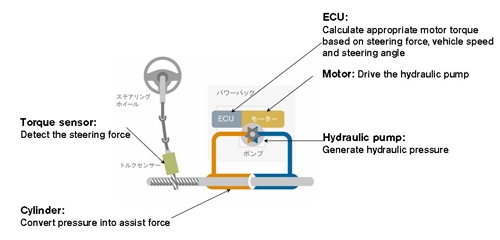
All vehicles equipped with power steering have a hydraulic power steering pump that is driven by a belt and pulley attached to the engine. The pump is bolted to an offset bracket on the front of the engine, and either has an integral reservoir for the fluid or a separate remotely located reservoir.
A pair of hoses transfer the fluid pressure from the rear of the pump to the steering gear. One hose — which is threaded into the pump — is the high-pressure line to the gear. The second hose - or the low-pressure return line - is simply secured to the pump reservoir with a hose clamp. The inside of the pump cavity contains an eccentric chamber.
Around the driveshaft on the inside of the chamber are a series of moveable blades that conform to the eccentric design of the chamber to provide the necessary hydraulic pressure. A pressure relief valve maintains the proper pressure and allows the excess to return to the reservoir.
As a note, this valve, when defective, can cause a continuous noise similar to buzzing or whining. Late model vehicles achieve directional control through a rack and pinion steering gear mechanism situated on a crossmember between the tires. The rack and pinion resembles a long tube with an extension from the tube on the driver’s side for steering column input. The rack is a long rod that has gear teeth on its topside. A geared input shaft meshes with the rack teeth and moves the rack to the left or right. A set of tie rod are placed on the ends of the rack. These tie rods connect to the steering knuckle that allows the wheels to pivot for directional control.
Rack and pinion steering took the place of the steering gearbox due to its overall reduction in weight and increased sensitivity. It also eliminates all the linkages that were necessary for the older gearbox to work. However, the steering gearbox can withstand far more abuse and is still employed in many trucks and SUVs.
The missing QTCF.dll file is the most common.dll file that we are aware of. It is possible that other corrupted.dll files, related to other applications, could impact. Search your system for the file QTCF.dll (make sure your search includes hidden and system files). It will be located here: C:Program Files. Dll has been deleted or misplaced, corrupted by malicious software present on your PC or a damaged Windows registry. The DLL‑files.com Client can help you properly install qtcf. Dll and fix your DLL error permanently. About QTCF.dll errors. When an application requires QTCF.dll, Windows will check the application and system folders for this.dll file. If the file is missing you. Qtcf.dll file.
Power steering fluid under high pressure enters the rack and pinion through a rotary valve. A torsion bar twists when the steering column is turned and opens passages in the rotary valve, directing fluid to the appropriate side of the steering rack. A partition in the rack separates the left from the right. Pressure is applied to one side or the other, forcing the rack to move in the desired direction.
The faster the steering wheel is turned the more the torsion bar is bent, allowing more fluid to pass through the rotary valve and into the rack and pinion. One of the oldest types of steering transference is the steering gearbox. The gearbox is a cast iron box on the driver’s side frame rail and consists of a sector shaft and pitman arm gear.
Advantages Of Power Assisted Steering Vs Manual Steering Parts
When the steering wheel is turned, the sector shaft turns in the same direction and moves up or down in its housing. In turn, the shaft rotates the pitman gear perpendicular to the shaft’s movement as the pitman arm’s gear engages with the threads of the sector shaft. The steering gearbox also uses a rotary valve and torsion rod to direct hydraulic fluid. The rotary valve is a round, slotted piece that, when uncovered, directs fluid to the top or bottom of the gear.
As the steering wheel moves, it increases friction against the torsion bar, which bends and opens the rotary valve's slots. The degree to which the torsion bar bends determines the amount of pressure applied or degree of steering assist.
Power Assisted Steering System
Some vehicles built from 1950 until 1980, such as those built by Ford, used a different type of system that employed a manual steering gear box, but with a hydraulic slave cylinder attached to the frame and rag link. A control valve was attached to the pitman arm that acted in much the same capacity as the rotary valve and torsion bar used in later model systems.
The valve controlled the amount of pressure sent to the hydraulic piston. In turn, the hydraulic piston pushes or pulls on the drag link depending on which side of the piston the pressure was applied and, in effect, multiplies the steering input. Electronic power steering is the future of power steering and has been employed by a variety of manufacturers, but has not yet seen full production as of 2012. This steering system utilizes a computer-controlled electric motor coupled to the steering mechanism with a belt.
It is beneficial in that it has no other parts, such as a pump, fluid or hoses, and requires only enough horsepower to meet the alternator's increased demand. Electronic power steering does not feel any different from the the other methods; however, the amount of assist is infinitely adjustable and can be changed with a simple program.
Feedback is the name of the game. I have been driving a car with manual steering for over a year now, and I can say that manual steering gives you much more feedback when compared to assisted steering.What is feedback?90% of the time on everyday commuting, feedback isn't worth a dime, unless you are an enthusiast, but when you are on a track day, proper feedback from your tires lets you brake late.