Wilderness Emt Patch
This article needs additional citations for. Unsourced material may be challenged and removed.Find sources: – ( July 2011) Wilderness first responders are individuals who are trained to respond to emergency situations in remote locations.
They are part of a wide variety of wilderness medical providers who deal with medical emergencies that occur in wilderness settings.History Near the end of the 19th century, volunteer organizations such as began teaching the principles of first aid at mining sites and near large railway centers. By the dawn of the 20th Century, additional organizations such as the and the began teaching first aid to lay people. Over the years, these organizations trained hundreds of thousands of people in the elements of providing assistance until definitive care could be arranged.The training in these courses assumed that definitive care was nearby and could be delivered quickly.
Eventually it was realized that this training, while valuable, needed to be supplemented and/or revised to deal with the extended time and limited resources inherent when a medical crisis occurs in a wilderness setting. In the 1950s, organizations such as began developing training programs that addressed these special needs.In 1966, the US Government, through the, gave the (DOT) responsibility for creating a national System (EMS). From this program came the standardized curriculum for the position of (EMT).Wilderness Medicine Outfitters' director taught his first back-country care course for ski patrollers at Colorado State Univ in 1967. The first course was taught in 1976 to help EMTs in Colorado adapt their skills and knowledge when working with Search and Rescue teams. By 1977, organizations such as (SOLO) were offering specialized training to their instructors.Meanwhile, the DOT EMS program recognized a need to develop standardized training for such as truck drivers, policemen and fireman who could lend assistance during the initial part of the ' until an ambulance with an EMT arrived. In 1984, SOLO developed and taught the first wilderness first responder course. The purpose of creating the course was to provide Rangers, outdoor leaders, and guides the necessary knowledge to provide care in crisis situations in the wilderness.
In 1985, SOLO began providing WFR training to instructors in Florida.Today, WFR certification is frequently a prerequisite for professional positions that involve work in the outdoors and students may take courses from numerous nationally recognized providers (see below).Description A wilderness first responder is trained to deal with many situations that may be encountered in the wilderness. The training is principally geared towards lay providers, with little to no actual medical experience, though they are often already professionals in other aspects of the outdoors industry, like park rangers, climbing instructors, and guides. A standard Department of Transportation defined (EMR) course, which focuses on urban medical emergencies, requires approximately 60 hours of training, while its backcountry counterpart, wilderness first responder course, typically involves 80 hours of training, covering much of what is taught in an EMR course, but with the additional hours spent putting it in a wilderness context. Wilderness first responder training courses focus on teaching the students to assess a situation, improvise solutions using available resources to stabilize the patient, and identify the best way to get the patient to definitive medical treatment. In many courses, students are encouraged to develop the habit of systematically thinking through and documenting their assessment decisions/plans using a. Topics covered usually include, but are not limited to, the following principles:.
responding to results of:. management of signs and symptoms of. management of such as a burn or wound.
prevention and/or treatment of blood-borne. treatment of infectious diseases. management of bone and joint injuries such as, strains and. management of suspected head and or.
responding to the onset of sudden illness. transport/evacuation planning and implementation.WFR designation Wilderness first responder is usually abbreviated as WFR. Those with the certification are often called 'Woofers'.See also.References.

From Scouts-L:'Some years ago, the Red Cross rectangular 'Emergency First Aid' patch was authorized for wear on the Scout Uniform on the right sleeve below the positions for the flag and region/local emblems (position 3 in current insignia guide parlance). This emblem is no longer available from the Red Cross, however.I agree that there should be a BSA emblem of similar design available for use in this position which indicates such credentials for those who have have either first responder or emergency medical technician/paramedic pre-hospital care training.
Moreover, similar emblems could/should be created for physician and registered nurse. This would replace the current round 'physician' patch which is worn in position 2 or 3 on the left sleeve, if memory serves. This would be preferable to the current round emblem, since these folks often hold unit staff positions as well. Such an emblem would also preclude wearing the 'quality unit' emblem now currently worn in position 3 on the right sleeve, however. Perhaps a 'generic' 'emergency medical services' emblem could be created if it is too difficult to provide specific training/licensure designations as noted above.
Wilderness Emt Courses
Some control would need to be maintained to ensure that only those with specified and current training credentials (e.g., physician, nurse, emt, paramedic, or first responder) would be allowed to obtain/wear the insignia. An application form could be used to register those individuals with the local council which would also create a data base of such qualified individuals for resources when needed for events such as day camps, summer camps, etc.' (Bob Amick, Mon, 20 Jul 1998 08:42:07 -0600). As already posted, nothing for your scout uniform. As an EMT & Firefigher you bring a host of skills that work well in scouting.Each rank of Cub Scouting has a first aid requirement. More than likely you are also a CPR instructor or have access to one.
You might think about organizing a basic first aid course and/or a CPR course for all the adult leaders. Additionally you could offer to teach the first aid requirements for each of the ranks making it easier on the other den leaders. It puts a new adult in front of the boys instead of the same people everytime. The boys will enjoy a different presenter, the den leaders will enjoy a chance to learn instead of present, and you get a chance to share you wealth of knowledge.There is also the BSA Preparedness Badge available for all ranks.
You could take this on as a personal task to ensure that all the boys in your Pack are exposed to the information and given the opportunity to fullfill the requirements via your tutoring.At the Boy Scout level you could volunteer to be a Merit Badge counsler for Firemanship, First Aid, Safety, Emergency Preparedness, and probably a few others.I know my training as an EMT, Firefighter, and Rescue Technician have helped me in scouting. While there is no badge to wear on your uniform, there are lots of opportunties for you to share your skills. Some years ago, the Red Cross rectangular 'Emergency First Aid' patch was authorized for wear on the Scout Uniform on the right sleeve below the positions for the flag and region/local emblems (position 3 in current insignia guide parlance). This emblem is no longer available from the Red Cross, however.Since this patch has already been authorized by the BSA you might:1) Try the patch traders' forum to see where you can purchase a used one. I couldn't find one on eBay, but I'm sure that there are boxes of them somewhere.2) Investigate the process of making patches from a computer scan of the original patch. I can get a scan if your are interested.
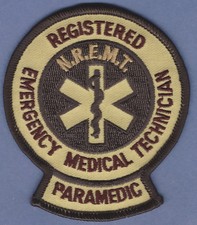
I believe that this kind of equipment is even available to sewing hobbyists, so someone in your community (your church or sponsoring organization, for example) might do it for free.3) See what is involved in getting the Red Cross to reissue the patch. If they are unwilling, see if the Red Cross's competitors would be willing to step up (Fortunately Congress did not grant the Red Cross a monopoly on the words 'Emergency First Aid'). You might already belong to such a public service organization.4) Given the common perception last summer that the BSA could be more 'prepared' in making the safety of their Scouts a priority, perhaps this is the perfect time for some good deed doer to use his connections to create a new official national badge of some sort, or to at least make available the Red Cross badge one way or another.Of course, you could just wear a commonly available EMT patch on your right 'temporary patch' pocket. I doubt that anyone would object, but to make it official you might talk someone at your local Council into 'authorizing' such a local temporary patch.Kudu. Several scouters, includng myself, are EMT's in my District, and we do First Aid at District/Council events. We all wear Pennsylvania EMT patches (1 wears a Medic patch).
I earned my EMT when I was 16, and I still wear the same shirt as I did when I was 17. My patch is above my right pocket (with room for a nameplate) - this is the standard position for Jambo patches (Calm down. I know it isn't sanctioned by National).At least one was Staff at Jambo.
His is on his Left Breast pocket. I will probably be moving mine there sometime soon (next time I've got to sew patches).As a Leader, there isn't any emblem on the left pocket. Seems like a good place for me.And yes, if there was a nationally approved 'EMS' or even 'first aid' patch I would be first in line for it.JonPA State EMT since 2001. 'Several scouters, includng myself, are EMT's in my District, and we do First Aid at District/Council events. We all wear Pennsylvania EMT patches (1 wears a Medic patch). I earned my EMT when I was 16, and I still wear the same shirt as I did when I was 17. My patch is above my right pocket (with room for a nameplate) - this is the standard position for Jambo patches.'
I'm not a UP, but, as you note, it doesnt go there.A more appropriate location is the RIGHT POCKET.' At least one was Staff at Jambo. His is on his Left Breast pocket. I will probably be moving mine there sometime soon (next time I've got to sew patches).As a Leader, there isn't any emblem on the left pocket. Seems like a good place for me. Use the RIGHT Pocket. The left pocket is were we wear the Powder Horn medal.Also, at District/Council events, I wouldn't be upset if you made up armbands to wear with your EMT emblem on it.
Akela in NY,Greetings!I believe it may now be discontinued, but there was previously an adult position called 'physician'. It had the BSA and Eagle emblem about a blue Medical Staff and snakes, on a twill cloth and blue border. On the adult uniform, Left Sleeve Position three.I have normally seen the Council Health and Safety Committee wear this, as well as the Camp Medic.I tried to find a good example on the web, but this is all I could see in a few short searches. The issue/sale of the Physician patch was probably discontinued in the recent few years.I'm not endorsing anyone or business. But if you do a google image search for Boy Scout Physician you may see it at an expired Cub Scout page www.cubscout.ws.
Also, a long time Scouter and Trader Mitch Ries has one for sale for $10.00 on his website.Scouting Forever and Venture On!Crew21 Adv. 'I like the idea of placing it on the RIGHT pocket as a 'temporary' patch.' I would do this, too - But our Council Camp does the 'patch with segments' and, having been doing this long enough, the patch has an impressive amount of segments. And they've sort of become permanant on that shirt. I'm NOT sewing them on again.Many scouts and scouters in the council wear temporary insignia either over the camp patch (in a holder or w/ a button loop, or they wear temporary insignia over the right pocket.As I said - I know the UP folks will have a heart attack reading this.

But this is common practice in our council - and as for the UP types having heart attacks - well, this discussion involves those who can help with that. 'I would do this, too - But our Council Camp does the 'patch with segments' and, having been doing this long enough, the patch has an impressive amount of segments. And they've sort of become permanant on that shirt. I'm NOT sewing them on again.' Ok, understandable.' Many scouts and scouters in the council wear temporary insignia either over the camp patch (in a holder or w/ a button loop, or they wear temporary insignia over the right pocket.'
Temporary insignia over the right pocket is totally wrong. As noted, that space is reserved for Jamboree patches only.Wearing a patch in a holder or w/ a button loop (in my area almost all OA patches have button loops) over the right pocket is a very good solution.'
Medicine In The Wild
Wfr Training
As I said - I know the UP folks will have a heart attack reading this. I'm a sticker for proper uniforming, but I think the solution of wearing it in a holder or with a button loop on the right pocket is just fine.