Game Co Tuong Xiexiemaster
Tu Sac Card SetsThe following are valid card sets in Tu Sac:. A single king. A pairs of identical cards.
A triple of identical cards. A quadruple of identical cards.
A set of king/guard/minister cards of the same color. A set of rook/cannon/knight cards of the same color.
A set of 3 or 4 pawns of different colorsA hand in Tu Sac consists of 20 cards and possibly one additional active card. The cards are further divided into a public block that everyone can see, and a private block that only the owner of the hand can see. The public block always consists of a number of valid sets, while the private blocks may contain one or more trash cards, cards that are not yet in any valid set. The number of trash cards a hand has is the minimum number of cards the removal of which leaves the private block a combination of valid sets.A few sets of cards have special names. A quadruple set of cards originally in a hand is called a Quan.
Chinese Chess Board
A Quan must be shown to all players at the beginning of the game. A triple set of cards in the private block of a hand is called a Khap. The number of Khap that a player has must be announced to all players. This number is denoted by one or more small dots on the game board. A quadruple set formed by melding a Khap with the active card is called a Khui.
Quan, Khui, and Khap have special meaning when computing the winning amount after each game. Playing Tu SacThe game is for 2-4 people and it is best to play the game with 4 people.Each player initially has 20 cards except the first player who has 21 cards.
The remaining deck of cards is left in the middle of the game table.The game starts with the first player discarding one of his trash card.This card becomes the active card in the game. The next player can meldthe active card, creating a valid set of cards consisting of up to 3private cards he has on his private hand and the active card. If a playercannot meld the card, he can hit the remaining deck for a new card, and thiscard becomes the active card. He then has another chance to meld the activecard. If he still cannot meld the card, he loses his turn and the gamecontinues with the next player. If in one of the two opportunities, theactive card is melt, the person who melds the card then discards one ofhis trash card out.
The card becomes the active card, and the game continuewith the next player.There are a number of times when melding the active card is done by someone other than the current player. In these cases, the person who does the melding becomes the current player, and the game continues from that person. These special situations are covered later.The objective of the game is to get rid of all trash cards by either melding them with the active card or by discarding them. The first player whose hand doesnot have any trash after melding the active card wins the game. In the case when no one wins and there are only 7 cards left in the remaining pile, the game is aborted. The game is drawn in this case.
Tu Sac Special Melding RulesA number of special rules govern the melding and discarding of cards. Followings are the rules, in decreasing priority. When two or more rules can be used, higher priority rules take precedent. Winning priority: If the active card could be melt in any way to complete someone's hand, even when he is not the current player, the active card is melt to that hand so that the person wins the game. Khap priority: A Khap cannot be broken, i.e.
A card in a Khap cannot be combined with any other private card to form a set. When the active card is the same as the card in a Khap, the player owning that Khap must immediately meld the active card to form a Khui and becomes the current player. Trash reduction priority: When a person discard a card, he must decrease the number of trash in his private hand, i.e.
The card being discarded must be a trash. Whenever a person melds a card, he must not increase the number of trash in his private hand. Pair priority: If a person has a pair of card, and that card is an active card, and it is someone else's turn, he must meld the active card to form a triple and take over the turn from the current player.There are two exceptions to the pair priority rule. Firstly, the rule cannot be used to meld a king card.
Secondly, if a person has exactly 2 trash cards left, and the trash cards are either 2 pawns of different colors, a rook and a cannon, or a rook and a knight, or a cannon and a knight, then he cannot use the pair priority rule. Penalty RuleTo ensure fairness, each player should make the best effortto win the game. In Tu Sac, it is a requirement that each playerdoes so or risks receiving a penalty.When discarding a card after melding the active card,a player should always discard the worst cardhe has on hand, taking into account what he may hit in his next round.If a player does not follow this rule, and the card he discards is meltto form a winning hand by someone else, the player is penalized, payingthe winning amount for other losing players in the game.Determining whether a card is the worst card or not is quite confusingunless you are an experienced player. Luckily, when playing at Vinagames,you will be told whether a trash card you are about to discard isworst or not, see later section on playing at Vinagames. Calculating Winning AmountsOnce a person completes his hand and wins, all losing players pay the winner an amount based on the valid sets in his cards.
A Quan, Khui, Khap are valued at 8, 6, and 3 points respectively. A set of 4 pawns is valued at 2 points, a pair does not have any value, and all other sets are valued at 1 point.The amount each player pays to the winner is (3+handvalue) + 10. If the winner has a Quan or a Khui, the winning amount is then (3+handvalue).2 + 10.Players that do not win the game also receive a number of side points if they have Quan, Khui, or Khap. The winner must pay for Quan and Khui, and all other players must pay for Quan, Khui, and Khap. Playing Tu Sac at VinagamesPlaying Tu Sac at Vinagames is easy, whether you are a beginner or anexperienced player.
All the melding required by Tu Sac rules are doneautomatically, and the program hides all the complexity of checking whetherthe card being discarded is worst or not.When it is your turn to play, if you wish to meld the active card,you can select an appropriate set of your private cards and click on 'Meld'.If you wish to hit for a new active card, deselect all the cards and clickon 'Hit'. If you cannot or do not wish to meld a card after hitting,you can click on 'Pass'. To discard a card after melding, you can selectit and click on 'Discard'. The button for discard turns to'Discard!!!' If the card you select is not the worst trash you have.There are 2 buttons that help you with the organization of your privatecards.
Clicking on 'Find Trash' will cycle you through all your trashcards, all the trash cards that are safe for you to play (i.e. The worst cards),and to deselect all your cards. Click on 'Quick Select' one or more times to quickly select the cards that you can use to meld the current card or a trash to discard.If you are new to the game, you can blindly click on 'Quick Select' thenon the action button, regardless of it being 'Meld', 'Hit', 'Pass', 'Discard'.You may not play well, but at least your play is valid.
Qianhong is top recommended free Chinese chess and a remarkably user-friendly program for anyone new to the game. Same as other programs selected in this page, it helpfully provides an English user interface. You can opt for alternative board designs (in scalable sizes to suit your screen) and select Western-style chessmen. A complete Help manual is included.To familiarize yourself with the game, you may find it useful to watch the computer play itself.
When you decide to join in, Qianhong can also give you hints for your next move. Opening-book and end-game resources are also available.Qianhong installs with a relatively weak built-in engine, which you may find fun to play against if you’re just starting out.
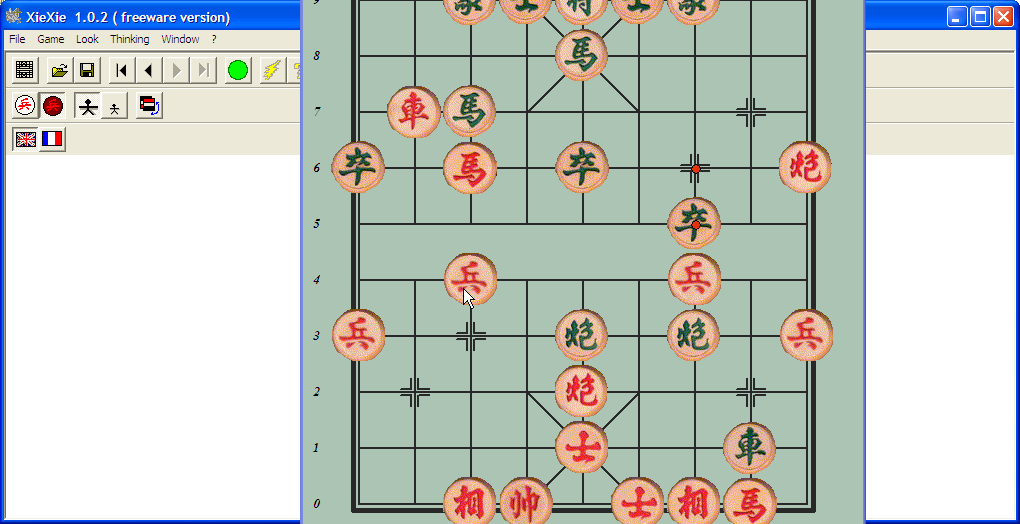
However, you can also install a selection of stronger third-party engines, provided as plug-ins.A particularly versatile (and popular) one is ElephantEye, and this can be set to six levels of strength ranging from ‘Beginner’ to ‘Overwhelming’. If you get to beat ElephantEye at the fifth level, you’ll have reached Grand Master level.XieXie Freeware, a free version of XieXie Master, comes with rich features and a built-in engine strong enough for most players. You can choose a suitable level ranging from beginner to advanced, or select to play a handicapped or time limited game.It has a nice user interface with three different board sizes, various sets of chessmen, and different board styles and colors. Other useful features include hints on best next move, undo/redo moves, load and save games, build own opening books, etc.More advanced features, such as additional configuration of the chess engine, are only available in the paid version, but the free version is good enough for most average players.HiddenLynx is a good choice for practicing or playing Chinese Chess. The simple user interface highlights available moves when you place the mouse cursor over a piece—great for learning the game.


And you can undo and redo your moves.The program comes with a built-in engine with 5 levels of strength. It saves games automatically, so you can adjourn and return to the board whenever you want.Unlike Qianhong, HiddenLynx does not let you install third-party engines or edit opening books. But the program is portable. After downloading, just unzip to any folder you choose, click the executable, and start a game.Another free program Milo's Chinese C h ess is worth a try for practicing and playing the game as well. The 3D vivid interface together with animated legal moves enriches your game experience with the program.It has a built-in engine with 6 levels of strength. You can undo/redo moves, open and save games, play full-screen or windowed.Other display features include setting board texture, mirror effect and slide pieces, etc./ software/ miloches.